
You finally got that dead or dangerous tree removed from your Deltona property. The tree service came out, cut it down, hauled away the debris, and cleaned up. But there’s one problem: they left the stump.
Now you’ve got this unsightly remnant sitting in your yard—a constant reminder of the tree that used to be there. Maybe you’re thinking it’s not that big a deal. It’s just a stump. You can mow around it. Eventually it’ll rot away on its own, right?
Here’s what most Deltona homeowners don’t realize: that old stump isn’t just an eyesore. It’s actively damaging your property value, creating safety hazards, and inviting problems that get worse with every month you leave it there.
We’ve been providing professional tree service and tree removal throughout Deltona and Volusia County since 1995, and we’ve seen what happens when homeowners put off stump removal. What seems like a minor inconvenience becomes a genuine property problem that costs more to fix the longer you wait.
Let us explain exactly why that stump needs to go, what it’s doing to your property right now, and why professional stump grinding is the only real solution.
What Happens to Stumps Left in the Ground
When a tree is cut down, the stump that’s left behind doesn’t just sit there doing nothing. It’s organic material, and in Florida’s humid climate, organic material decays—but not in ways you want happening in your yard.
The Rot Process Attracts Pests
As the stump starts to rot, it becomes a magnet for insects. Termites love decaying wood. Carpenter ants move in. Beetles bore into the soft wood. These insects don’t stay confined to the stump—they eventually spread to other wood on your property.
We’ve responded to calls in Deltona where homeowners discovered termite infestations in their homes that traced back to old stumps in the yard. The insects established colonies in the rotting stump, then migrated to the house. What started as “just a stump” turned into thousands of dollars in termite damage and treatment.
Carpenter ants are another major problem. These large black ants hollow out wood to build their nests. An old stump provides perfect habitat. Once established, carpenter ant colonies can number in the thousands, and they don’t limit themselves to dead wood.
Fungal Growth and Disease
Rotting stumps develop fungal infections. You’ll see mushrooms sprouting around the base. Bracket fungi grow on the sides. These aren’t just unsightly—they’re producing millions of spores that spread throughout your property.
Some of these fungi can infect living trees. Armillaria root rot, for example, spreads through root contact. If your old stump is infected and its roots touch the roots of healthy trees in your yard, the disease transfers. You remove one problem tree only to create problems for the trees you wanted to keep.
Root System Stays Alive
Here’s something that surprises most homeowners: cutting down the tree doesn’t kill the root system immediately. Roots can stay alive for years, especially on certain species. They’ll send up shoots—new growth trying to regenerate the tree.
Those little sprouts that keep popping up around your old stump? That’s the root system trying to survive. You can mow them down or cut them back, but they’ll keep coming. The only way to truly stop them is to remove the stump and grind the major roots.
How Stumps Destroy Property Value
Real estate agents will tell you that curb appeal makes or breaks property values. An old stump sitting in your front yard isn’t just unattractive—it signals neglect to potential buyers.
First Impressions Matter
When buyers drive up to a property, they’re forming opinions in seconds. A well-maintained lawn says the owners care about the property. An old stump says the opposite. It suggests deferred maintenance, lack of attention to detail, and potential hidden problems.
We’ve talked to real estate agents in Deltona who specifically advise sellers to remove stumps before listing. Properties with stumps sit on the market longer and receive lower offers. Buyers use visible issues like stumps to negotiate price reductions.
Usable Yard Space Reduction
That stump takes up space—space you could be using for landscaping, a garden, a play area, or just a clean lawn. Buyers calculate usable yard space when evaluating properties. A stump reduces functional space.
If you’ve got a stump in your front yard, it limits landscaping options. In your backyard, it creates a dead zone where you can’t put a patio, pool, or garden bed. For properties in Deland and Deltona with smaller lots, every square foot matters.
Mowing and Maintenance Hassles
Anyone who’s tried to mow around a stump knows the frustration. You have to slow down, maneuver carefully, and make extra passes. Professional lawn services charge more for properties with obstacles. Some won’t service properties with multiple stumps at all.
Stumps also damage mowing equipment. Hit a stump with your mower blade and you’re looking at blade replacement or worse. We’ve seen homeowners bend mower decks, break belts, and even crack engine mounts by hitting stumps they didn’t see in tall grass. Just like regular tree pruning prevents problems with your living trees, removing stumps prevents ongoing maintenance headaches.
Safety and Liability Concerns
Stumps are tripping hazards. Kids running through the yard can catch a foot and fall. Adults walking in the evening might not see the stump in low light. Visitors to your property could trip and injure themselves—creating potential liability.
For properties with stumps near driveways or parking areas, there’s also vehicle damage risk. Back over a stump and you could damage your bumper, exhaust system, or undercarriage. We’ve seen stumps cause thousands in auto body repairs.
We’ve been helping Deltona homeowners eliminate these problems since 1995. Professional stump grinding removes the stump completely, restoring your property’s value and eliminating hazards. Call 386-259-8182 for a free assessment.
Why Stumps Don’t Just “Go Away”
Some homeowners think if they wait long enough, the stump will decompose naturally and disappear. This is technically true, but the timeline is far longer than most people realize.
Natural Decomposition Takes Decades
In Florida’s humid climate, a stump might fully decompose in 10-20 years for softer woods, 20-30+ years for hardwoods like oak. That’s decades of dealing with the problems we’ve described—pests, disease, safety hazards, reduced property value.
During those decades, the stump goes through phases. First, the bark loosens and falls off. The wood softens and becomes spongy. Fungal growth increases. The stump slowly collapses inward, creating a depression in your yard. But the root system remains largely intact for much of this time.
By the time natural decomposition finishes, you’ve lost decades of property use, dealt with years of pest attraction, and missed the benefit of that yard space.
DIY Removal Rarely Works
We’ve seen homeowners try various DIY stump removal methods. They dig around the stump. They use chemicals. They try burning it out. These approaches have serious problems.
Digging out a stump by hand is incredibly labor-intensive. Tree roots spread much wider than the visible stump, often extending 15-20 feet in all directions. Major roots can be 6-12 inches thick and buried 2-3 feet deep. Without proper equipment, manual removal is nearly impossible for any substantial tree.
Chemical stump removers accelerate decay but still take months to years to work. You drill holes in the stump, pour in chemicals, and wait. Meanwhile, you still have a stump in your yard, just one that’s slowly dissolving and potentially leaching chemicals into the soil.
Burning stumps is dangerous and often illegal in residential areas. Even where allowed, it’s hard to control, produces massive amounts of smoke, can damage surrounding lawn and plants, and rarely removes the entire stump and root system.
What Professional Stump Grinding Actually Does
Professional stump grinding is completely different from these DIY approaches. It’s fast, thorough, and leaves your property ready to use immediately.
The Grinding Process
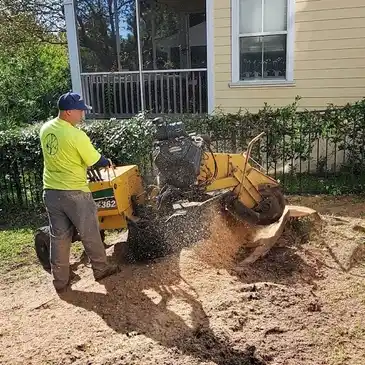
We use industrial stump grinders—heavy machines with carbide-toothed cutting wheels that spin at high speeds. The wheel chips away wood, reducing the stump to sawdust in minutes.
We grind the visible stump down below ground level—typically 6-12 inches below grade. This puts the remaining wood deep enough that you can plant grass over it, lay sod, or even replant a tree in the same spot. The major surface roots are also ground away, eliminating the tripping hazards and mowing obstacles.
The process is much faster than most homeowners expect. A typical residential stump takes 30 minutes to an hour to grind completely. We leave your property clean, with the stump gone and the hole filled with the wood chips we created during grinding.
What Happens to the Roots
The deep roots remain underground, but this isn’t a problem. Without the stump and surface roots, the root system has no way to regenerate. The buried roots will decay naturally over time without causing issues. They’re not visible, they don’t attract pests like exposed stumps do, and they don’t interfere with lawn maintenance.
For situations where you want to replant in the exact same spot, we can grind deeper or excavate the major roots. But for most properties, standard grinding depth is sufficient.
Benefits You See Immediately
The moment we finish grinding, your property looks better. That eyesore is gone. The tripping hazard is eliminated. You can mow over the area normally. Your yard has regained functional space.
For property owners in Ormond Beach and Deltona preparing to sell, stump grinding delivers instant curb appeal improvement. Landscapers can work with a clean slate. And if you’re planning to build—a shed, patio, or addition—stumps no longer limit your options.
When You Should Grind Stumps
The best time to grind a stump is immediately after tree removal. Most professional tree services will grind stumps as part of the removal or as an add-on service.
If you’ve already had trees removed and stumps were left behind, there’s no reason to wait. The problems we’ve described—pest attraction, safety hazards, property value reduction—start immediately and get worse over time.
Some situations especially call for prompt stump grinding:
You’re selling your property. Remove stumps before listing. The return on investment in terms of faster sale and higher price makes it worthwhile.
You’re planning landscaping. Stumps limit what you can do. Remove them first, then design your landscaping without working around obstacles.
You have kids or frequent visitors. The liability risk from tripping hazards isn’t worth the small expense of grinding.
You’re seeing pest activity. Termites or carpenter ants near an old stump mean it’s time for removal before the infestation spreads.
The stump is in a high-visibility area. Front yard stumps impact curb appeal more than backyard stumps, but both should be removed.
Frequently Asked Questions
How long does stump grinding take?
Most residential stumps take 30 minutes to an hour to grind completely. Larger stumps from mature trees might take longer, while small stumps can be finished in 15-20 minutes. We’re typically in and out the same day, with your property clean and ready to use immediately. The speed is one of the biggest advantages over DIY methods or natural decomposition.
Will grinding the stump kill the roots?
Grinding removes the stump and major surface roots, which eliminates the root system’s ability to regenerate or send up shoots. The deep roots remaining underground will decay naturally over time without causing problems. They won’t send up new growth because the energy source (the stump and surface roots) is gone. For most situations, this is completely sufficient.
Can I plant a new tree where the stump was?
Yes, but with some considerations. You can plant grass or small plants immediately over a ground stump. For planting another tree in the exact same spot, we recommend either grinding deeper than usual to remove more root material, or planting the new tree slightly offset from the original location. We can advise on the best approach for your specific situation when we assess your property.
What happens to the wood chips from grinding?
The grinding process creates a large pile of wood chips. We typically leave these on-site to fill the hole where the stump was. Excess chips can be spread in landscape beds as mulch, hauled away if you prefer, or left for you to use as you wish. Let us know your preference and we’ll handle the chips accordingly.
Stop Living With That Stump
That old stump in your Deltona yard isn’t going to magically disappear. Every month you leave it there, it’s costing you—in property value, in usable yard space, in pest attraction risk, and in daily frustration.
Professional stump grinding solves the problem permanently in less than an hour. You’ll get your yard back, eliminate the hazards, and immediately improve your property’s appearance and value.
At Arborist Action, we’ve been grinding stumps throughout Deltona and Volusia County since 1995. We have the equipment and experience to remove stumps quickly and completely, leaving your property clean and ready to use. Whether you have one stump or multiple stumps, whether they’re in your front yard or hidden in the back, we handle it all.
Call Arborist Action at 386-259-8182 for a free stump grinding assessment. We serve Deltona, Deland, Ormond Beach, and all of Volusia County. Let us help you reclaim your property and eliminate that eyesore once and for all.
Your yard deserves better than an old stump. Make the call today.

